
Table of Contents
- Why Most Winery Reviews Leave You Guessing
- How to Read Wine Ratings Without Getting Fooled
- Wine Review Scoring Systems: What the Numbers Miss
- How to Spot Paid-for or Affiliate Bias in Winery Reviews
- Winery Tasting Experience Reviews: What Visitors Actually Capture
- Your Winery Review Checklist: What a Useful Review Includes
- Digital Literacy for Wine Apps and Aggregator Sites
- Conclusion: Read Reviews Like a Local, Not a Tourist
- Frequently Asked Questions
Last Updated: October 9, 2026
Why Most Winery Reviews Leave You Guessing
Most winery reviews tell you how someone felt, not what you will actually experience. That is the core problem with what to look for in winery reviews: the useful signals are buried under adjectives. At Maison La Belle Vie Winery, we read reviews the same way you do, and we notice the same gaps. A five-star post that says “amazing vibes” tells you nothing about the pour sizes, the seating, or whether the staff explained the wine. The reviews worth trusting describe specifics: the setting, the service, the tasting itself. Below, we break down how to read a review so you can plan a visit with confidence instead of hope.
A review is only useful if it answers three questions: what did the visit include, how did it feel, and would the writer go back. If it skips all three, keep scrolling.
How to Read Wine Ratings Without Getting Fooled
A wine rating is a score, not a fact. It reflects one taster’s view on one day. The number looks precise, but it hides a lot of judgment.
Reading ratings well means asking what sits behind the number. Who scored it? What were they comparing it to? Did they taste it blind? A score with no context is just a mood ring.
What the 100-Point Scale Actually Measures
The 100-point scale is a scoring method where tasters award points for color, aroma, flavor, structure, and overall quality. A wine starts near 50 and climbs from there. In practice, most everyday wines land in the 80s, so a score of 88 and a score of 91 tell you very little about which bottle you will enjoy more.
What the scale measures is the taster’s impression. It does not measure whether you will like the wine. Your palate is the only judge that matters at your own table.
The Consumer vs. Critic Gap
Professional critics taste hundreds of wines and score against a shared standard. You taste one glass on a Friday night. That gap matters.
A critic may praise a wine for complexity and structure. You may just want something smooth to sip on the patio. Neither view is wrong. But a review written for critics often skips the details a visitor needs, like parking, seating, or whether the tasting room welcomes a quiet afternoon.
Wine Review Scoring Systems: What the Numbers Miss
Wine review scoring systems miss the parts of a visit you actually remember. A score cannot tell you if the room was loud, if the staff were warm, or if the pour was generous.
Here is what a number leaves out:
- Service pace: rushed or relaxed
- Setting: indoor, patio, or vineyard view
- Education: did staff explain the wine
- Value: what the tasting included
- Comfort: seating, noise, and space
A score of 90 says nothing about any of these. So treat the number as a starting point, not a verdict.
Why Price Does Not Always Equal Quality
A higher price often reflects scarcity, branding, or aging, not better taste. Many affordable bottles show real balance and typicity, the way a wine should taste for its varietal and wine region.
Price also tracks bottle aging and oak programs, which raise cost without guaranteeing a wine you will love. When you read a review, check whether the praise is about the wine itself or just the label.
TTB guidance on wine labeling and standards
How to Spot Paid-for or Affiliate Bias in Winery Reviews
Paid-for reviews are the biggest blind spot in wine content, and most competitors skip the topic entirely because their own business models depend on it. A glowing post may be an ad in disguise. The writer earns a commission when you click a booking link, so the praise is not neutral, and the incentive runs in one direction.
Here is the mechanism to understand: affiliate and sponsored content pays on clicks and conversions, not on accuracy. A writer who pans a winery earns nothing from that post. A writer who praises every stop on a sponsored tasting trail earns on all of them. That asymmetry, repeated across hundreds of posts, is what produces the wall of five-star reviews you see on travel and wine blogs.
Watch for these tells:
- Every wine gets a high score, with no real criticism
- Booking links appear before any honest detail
- The review never mentions a downside
- Photos look staged or press-kit polished
- The tone reads like marketing copy, not a visitor’s notes
- The same handful of wineries appear across many unrelated posts
- Prices, hours, or pour sizes are described vaguely or not at all
Now the harder skill: separating a disclosed partnership from a hidden one. A review that says “this visit was hosted” or “we received a complimentary tasting” is not automatically untrustworthy, it is disclosed, which is the standard the FTC’s rules on endorsements and reviews require. Undisclosed paid relationships are the problem, because you cannot weigh a recommendation you do not know was bought.
A practical verification habit: check whether the same site ever publishes a critical review. If every winery it covers earns praise, the site is not reviewing, it is promoting. Look for at least one named downside in a post, and treat its absence as a signal about the writer’s incentives, not the winery’s quality.
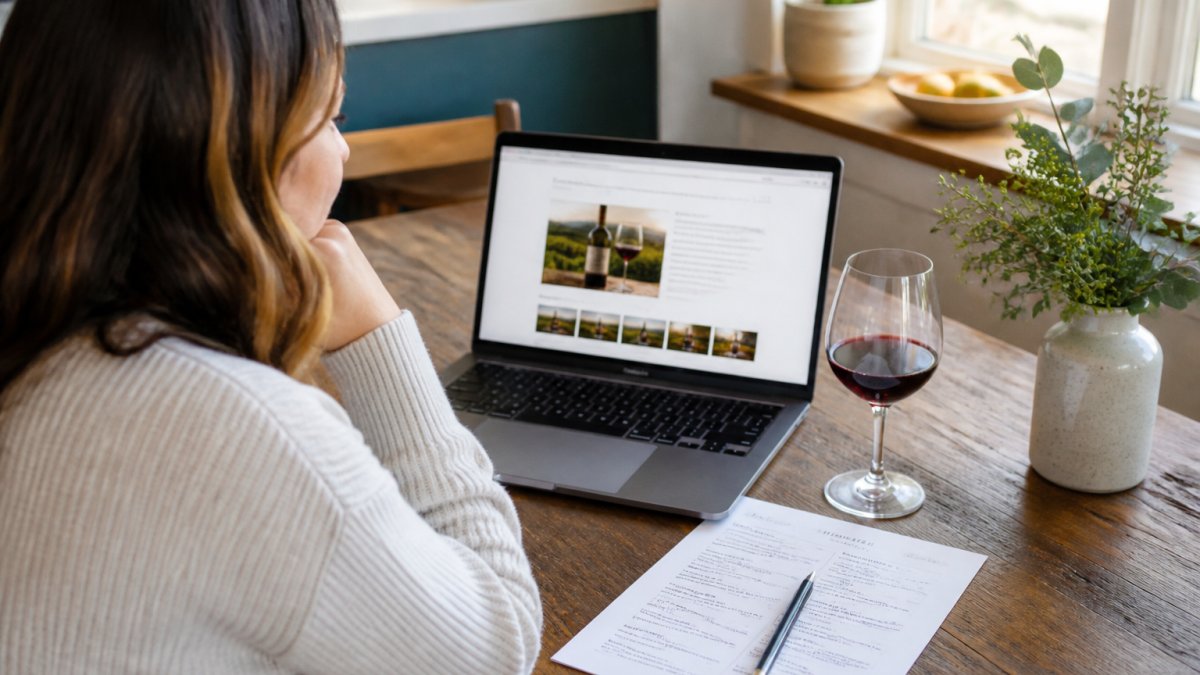
A review with a booking link, no disclosure, and no criticism is not a review. It is an advertisement with a byline.
Winery Tasting Experience Reviews: What Visitors Actually Capture
Winery tasting experience reviews capture what a score cannot: the feel of the visit. The best ones read like a short story with real details.
Look for reviews that name the wines poured, describe the room, and mention the staff by role. These signal a real visit, not a copy-paste blurb.
Sensory Details That Signal a Real Visit
A genuine review uses sensory analysis language. It mentions aroma profile, mouthfeel, tannins, and acidity. It notes the finish and whether the wine felt balanced.
These terms show the writer paid attention. A review that says “the red was good” tells you far less than one that says “the red had soft tannins and a long, fruity finish.”
When a review mentions a specific detail like a gravel path, a shaded patio, or a particular pour, treat it as a stronger signal than any star rating. Specifics are hard to fake.
Your Winery Review Checklist: What a Useful Review Includes
A useful review answers a short list of practical questions. Use this checklist before you trust one.
- Names at least two specific wines tasted
- Describes the setting and seating
- Notes the service and staff knowledge
- States what the tasting included
- Mentions any downside honestly
- Discloses paid or gifted visits
- Says whether the writer would return
If a review clears most of these boxes, it is worth your time. If it clears none, move on.
Reviews that never mention a single flaw are a red flag. No visit is perfect, so a flawless write-up usually means the writer had a reason to hide the rough edges.
Digital Literacy for Wine Apps and Aggregator Sites
Wine apps and aggregator sites pull scores from many sources, and they rarely show where each score came from. That makes them handy for a quick scan and risky as a final word. The core problem is that a user-generated average and a professional critic score measure two different things, and the apps present them side by side as if they were the same number.
A professional critic score reflects one trained taster’s view on one day, often tasted blind and scored against a shared standard. A user average reflects dozens or hundreds of self-selected drinkers, each rating against their own preferences, with no shared scale. A 4.2-star average and a 92-point score can describe the same bottle and tell you almost nothing about each other.
Use apps well with a few habits:
- Check how many reviews sit behind an average, a 4.5 from 6 ratings is noise, not signal
- Look for recent reviews, not just old ones, since vintages and staff change
- Read the lowest ratings first for real problems, not the highest for reassurance
- Cross-check a score against a written review that names specific wines
- Ignore scores with no named source or no date
- Watch for rating inflation: on many apps, anything below 4 stars reads as a warning even when the wine is fine
Apps reward volume, not accuracy. A wine with 400 reviews and a modest average often beats one with 12 glowing posts, because the larger sample has had more chances to surface a real complaint. The same logic applies to winery listings: a tasting room with 300 reviews averaging 4.3 is more informative than one with 9 reviews averaging 5.0.
Here is the consumer-versus-critic gap in practice. A critic may hand a wine 95 points for complexity and structure, the kind of wine that rewards attention and a decanter. A casual drinker on a patio may rate that same bottle 3 stars because it was tannic and tight on opening. Neither is wrong. The critic is scoring against a professional standard; the app user is scoring against a Friday night. When you read either, ask which question the number is answering.
Before you trust an app score, tap into the individual reviews behind it. If the average is built on short, undated, one-line ratings, treat it as a popularity signal, not a quality one.
Conclusion: Read Reviews Like a Local, Not a Tourist
The skill of reading winery reviews comes down to one habit: look for specifics, not stars. Seek out the details that tell you what a visit is really like, and treat every score with a healthy dose of doubt. At Maison La Belle Vie Winery, we built our tasting room, our on-site restaurant, and our estate-grown Muscat and Marechal Foch around the kind of visit that earns an honest review. Reserve a tasting and see the difference a real experience makes.
Frequently Asked Questions
What should I look for in a winery review?
A useful winery review names specific wines and vintages, describes sensory details like aroma, palate, and finish, and explains the setting. Look for details about the tasting room, staff knowledge, and whether the reviewer visited in person. Reviews that mention estate-grown fruit, tasting fees, or reservation policies tend to be more reliable than generic praise. Cross-check two or three sources before booking.
How can I tell if a winery review is trustworthy?
Check whether the reviewer discloses free tastings, hosted visits, or affiliate links. Trustworthy reviews include both positives and negatives, mention specific wines by name, and avoid vague language like ‘amazing experience.’ Look at the reviewer’s history: a pattern of five-star ratings across every winery suggests bias. Reviews with dates, photos, and details about the visit are more credible than anonymous star ratings.
Are wine ratings and winery experience reviews the same thing?
No. Wine ratings score a specific bottle, often on a 100-point scale, and focus on technical evaluation like tannins, acidity, and balance. Winery experience reviews cover the visit itself: tasting room atmosphere, staff, food pairings, and value. A winery can pour a 92-point wine but deliver a rushed, crowded tasting. Read both types together to get the full picture before you go.
What details should a useful winery review include?
A useful review covers the wines poured (with vintages), the tasting format, the setting, and the service. It should mention whether the winery grows its own grapes, how long the tasting lasts, and whether food is available. Details about accessibility, dog-friendliness, and group size limits help others plan. Reviews that skip these specifics and only say ‘great wine, beautiful views’ leave you guessing.
Planning a visit should feel exciting, not like a gamble. The next time you sort through winery reviews, you will know which ones to trust and which to skip. Maison La Belle Vie Winery offers curated tastings, estate-grown wines, and a full restaurant, all in one welcoming setting. Reserve a tasting and experience a visit worth writing about.